
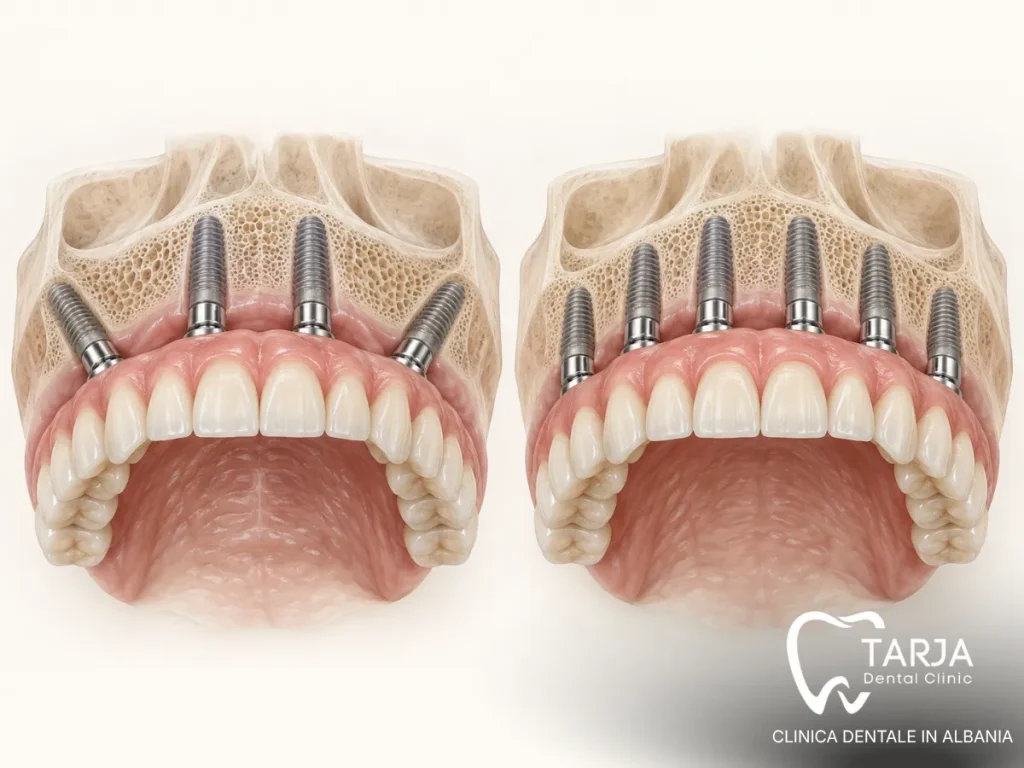
When comparing all on 4 vs all on 6, neither treatment is automatically better for every patient. Both approaches can replace a complete upper or lower arch with a fixed implant-supported bridge. The main difference is that one design uses four implants per arch and the other uses six. The right number depends on your available bone, implant positions, bite forces, medical and dental history, prosthetic design, hygiene access and treatment goals.
For some patients, four well-positioned implants provide appropriate support while reducing the number of implant sites. For others, six implants may create a wider support distribution when enough suitable bone is available. A panoramic X-ray can help with an initial discussion, but a final recommendation requires a clinical examination and usually three-dimensional imaging.
Short answer: All-on-4 may be preferable when a carefully planned four-implant configuration provides adequate support or when anatomy limits posterior implant placement. All-on-6 may be preferable when the jaw can safely accommodate six useful implant positions and the additional support fits the prosthetic plan. The decision should be based on the complete treatment design, not the number alone.
All on 4 vs All on 6 at a glance
| Factor | All-on-4 | All-on-6 |
|---|---|---|
| Implants per treated arch | Four | Six |
| Typical purpose | Supports one fixed full-arch restoration | Supports one fixed full-arch restoration |
| Implant distribution | Often uses tilted posterior implants to improve the front-to-back spread and work around anatomy | Uses two additional implant positions when adequate bone and space are available |
| Bone requirements | May be suitable when useful bone is concentrated in fewer strategic areas | Requires suitable bone at six planned sites; grafting may be considered if those sites are not available |
| Load distribution | Can perform well when implant position, bridge design and bite are properly controlled | May distribute support across more implants, but position and prosthetic design still matter |
| Surgery | Four implant sites per arch | Six implant sites per arch |
| Cost | Often lower because fewer implants and components are used | Often higher because two additional implants and components are used |
| Immediate provisional teeth | Possible in selected cases if clinical loading criteria are met | Possible in selected cases if clinical loading criteria are met |
| Best choice | Determined after examination, CBCT assessment, bite analysis and prosthetically driven planning | |
This comparison describes common planning principles, not a rule for every jaw. Even within the same patient, the upper and lower arches may require different configurations.
What are All-on-4 dental implants?
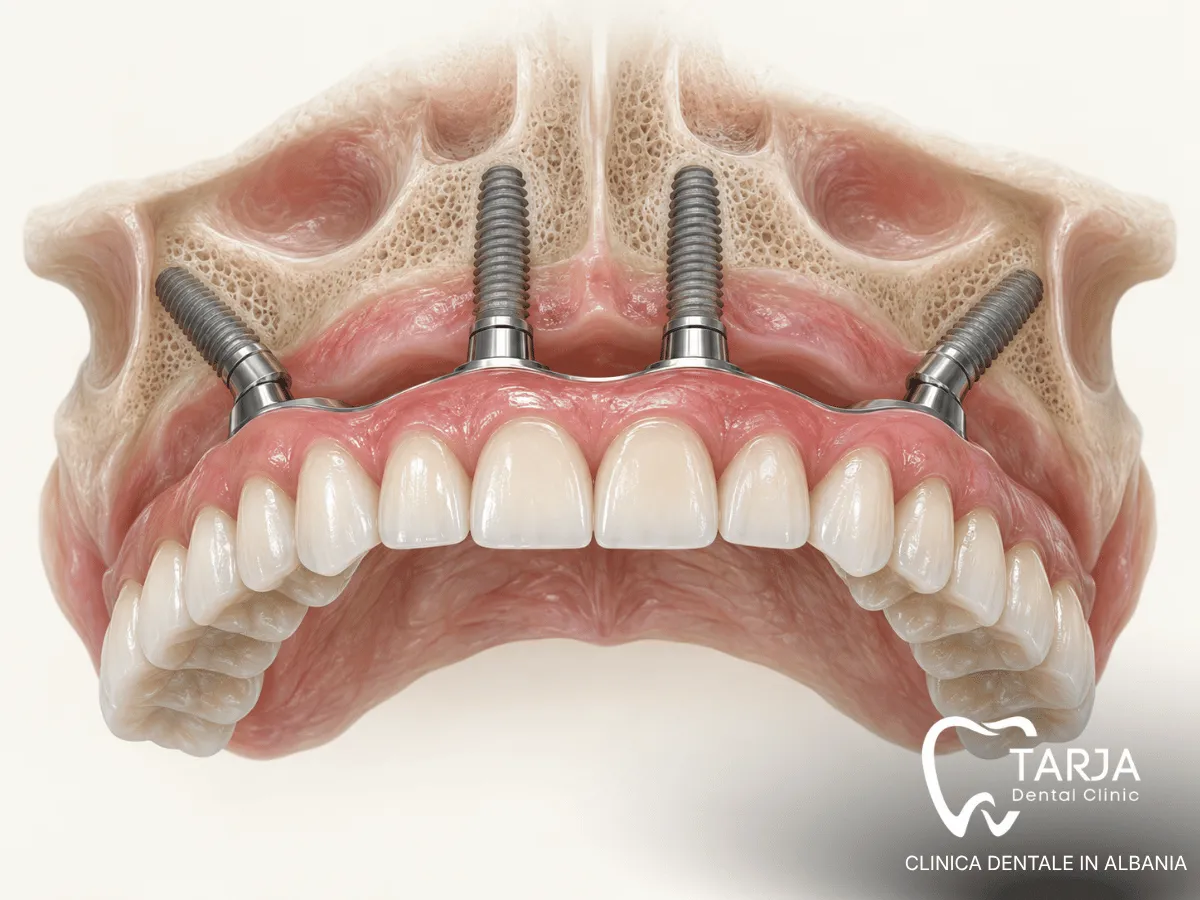
All-on-4 dental implants use four implants to support a fixed bridge that replaces an entire arch of teeth. A common design places two implants more vertically in the front and two posterior implants at an angle. Tilting the posterior implants can increase the front-to-back distribution of support and may help avoid anatomical structures in selected cases.
All-on-4 is not simply “four screws and a set of teeth.” Its performance depends on implant length and diameter, bone quality, insertion stability, implant spread, bridge material, cantilever length, bite design and the patient’s ability to maintain the restoration. A well-designed four-implant plan can be a valid long-term solution, but four is not the correct number for every patient.
Potential advantages of All-on-4
- Fewer implant sites than a six-implant configuration
- May use available bone strategically and avoid grafting in some, but not all, cases
- Usually involves fewer implant components
- Often has a lower treatment cost than an otherwise comparable six-implant plan
- Can support a fixed provisional restoration when adequate primary stability and other loading criteria are achieved
Points that require careful planning
- Each implant is an important part of a four-implant support system
- Poor implant distribution or a long unsupported extension can increase mechanical demands
- Heavy grinding or clenching may require changes to the design, material or loading protocol
- Immediate fixed teeth cannot be promised before stability is measured during treatment
What are All-on-6 dental implants?
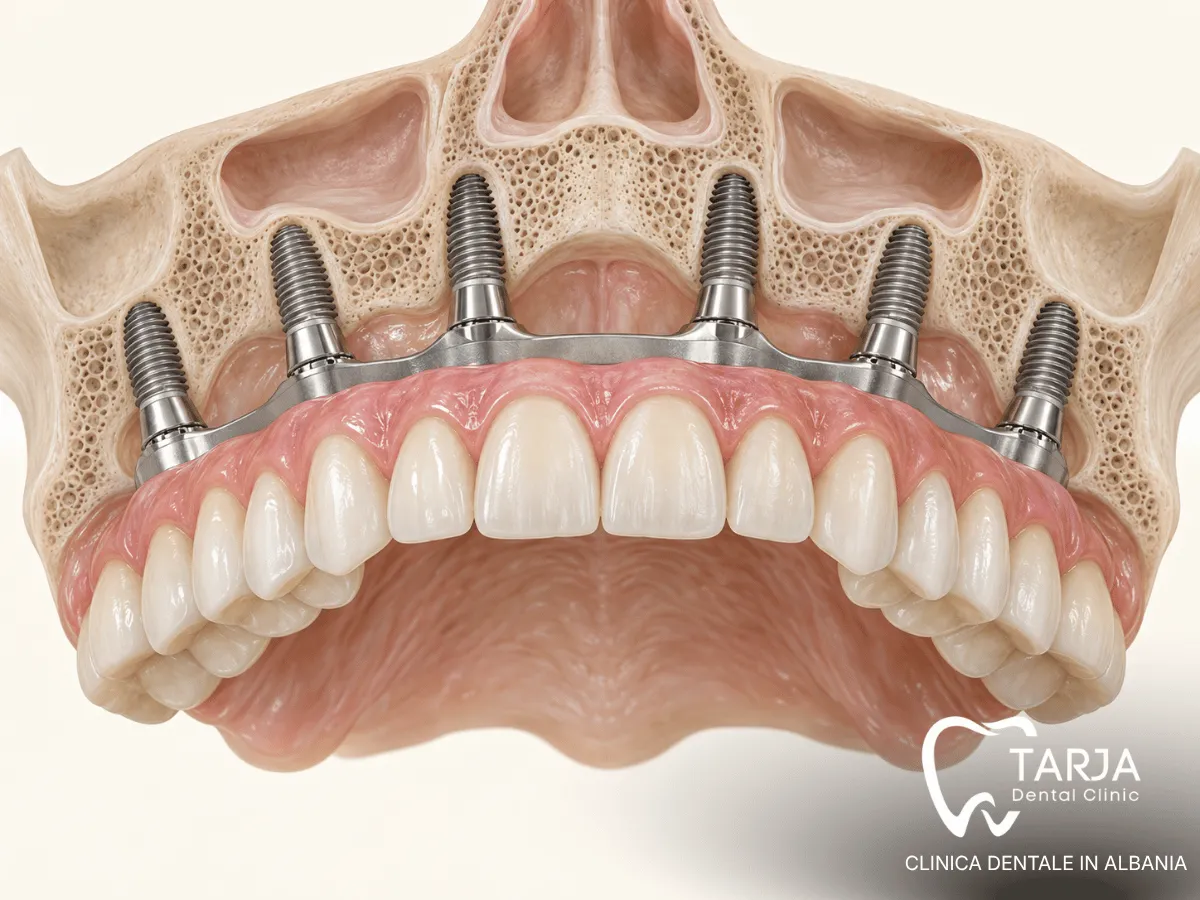
All-on-6 dental implants use six implants to support a fixed full-arch bridge. The two additional implants may allow the support to be distributed across more positions. This can be useful when the anatomy, arch shape and prosthetic plan permit a meaningful six-implant layout.
More implants do not automatically produce a better result. Six implants must be placed in clinically useful positions, surrounded by suitable bone and incorporated into a sound restorative design. Placing additional implants too close together or only where bone happens to be available does not replace prosthetically driven planning.
Potential advantages of All-on-6
- Support may be distributed across six implants rather than four
- The configuration may reduce the load carried by each implant in a well-designed case
- A wider implant spread may help the restorative team manage the bridge design and posterior support
- It may be preferred for selected patients when bone volume, bite forces and restorative space are favorable
Points that require careful planning
- Six suitable implant sites must be available
- Additional surgery or bone augmentation may be needed if planned sites lack adequate bone
- Two extra implants generally increase the number of components and treatment cost
- Cleaning access must still be designed beneath the full-arch bridge
Is All-on-6 stronger than All-on-4?
All-on-6 can provide more support points, but “stronger” is too simple a way to compare the treatments. Full-arch performance is influenced by the position and angulation of the implants, the distance between the front and back implants, bone quality, the length of any cantilever, bridge rigidity, the opposing teeth and the patient’s bite.
When evaluating All on 4 vs All on 6 outcomes, the published evidence needs context. A recent systematic review and meta-analysis comparing four and six implants for the edentulous jaw reported broadly comparable survival outcomes, while also identifying differences in some secondary clinical measures. A separate 2024 systematic review focused on fixed restorations in the upper jaw found no statistically significant difference in implant or prosthesis survival between four- and six-implant groups, although marginal bone loss was higher in the four-implant group in the included evidence. These findings do not mean that six implants are necessary for everyone. They show why anatomy and design must be evaluated alongside implant count.
Long-term and observational research has also shown that fixed full-arch restorations can succeed on either four or six implants. However, the studies use different patients, implant systems, loading protocols, prosthetic materials and follow-up periods. Research can guide planning, but it cannot select the correct configuration for an individual jaw without clinical data.
For readers who want to examine the evidence directly, see the 2026 systematic review of All-on-4 and All-on-6 fixed prostheses, the 2024 systematic review of four versus six implants in the edentulous maxilla, and the 10-year comparative follow-up indexed by the U.S. National Library of Medicine.
Seven factors that determine whether four or six implants are appropriate
1. Bone volume and bone quality
The dentist must evaluate both how much bone is present and whether it is suitable at the planned implant sites. The upper jaw often presents different anatomical and density challenges from the lower jaw. A two-dimensional panoramic image is useful for screening, but a CBCT scan provides three-dimensional information about bone dimensions and nearby structures.
All-on-4 may use available anterior bone and tilted posterior implants in selected cases. All-on-6 needs six useful sites. Neither approach guarantees that bone grafting will be avoided.
2. Implant distribution
Where the implants are positioned can matter as much as how many are placed. The restorative team aims to create an appropriate front-to-back spread while respecting the sinus, nerve and other anatomical limits. Six poorly distributed implants are not necessarily better than four implants in favorable positions.
3. Bite forces and bruxism
Grinding, clenching, strong chewing muscles and the type of teeth in the opposing arch can alter the forces acting on the bridge. These factors may affect the number and dimensions of implants, prosthetic material, bridge shape, occlusal design and whether a protective night guard is advised.
4. The upper or lower arch
The same solution should not be copied automatically from one arch to the other. The maxilla and mandible differ in anatomy and bone characteristics. Some patients may receive four implants in one arch and six in the other when the clinical findings support that combination.
5. The planned prosthesis
The implant plan should begin with the intended tooth position and bridge design. Restorative space, lip support, speech, material thickness, cantilever length and hygiene access all influence the result. This is why full-arch planning should be prosthetically driven rather than based only on where implants can be placed.
6. General health and healing risks
Medical history, medications, smoking, diabetes control, previous periodontal disease and healing capacity can influence implant treatment. The U.S. Food and Drug Administration’s patient guidance on dental implants notes that overall health affects candidacy and healing, while smoking may delay healing and reduce long-term success. These risks require individual assessment; they are not solved simply by adding more implants.
7. Maintenance and access to care
A fixed full-arch restoration still requires daily cleaning and professional maintenance. The contours beneath the bridge must allow the patient to use the recommended brushes, flossing aids or oral irrigator. Long-term planning should also consider where routine checks and urgent repairs will be completed, especially for patients traveling internationally.
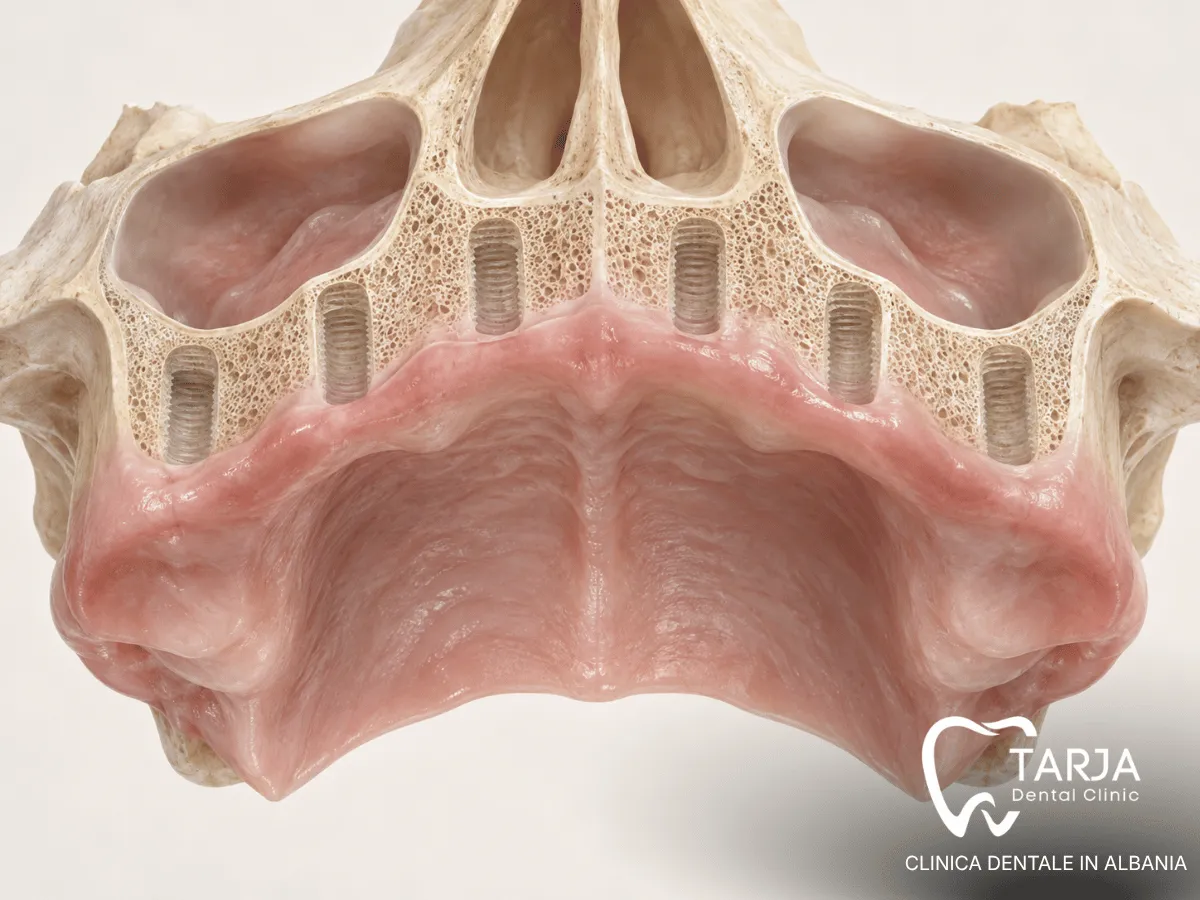
Does All-on-4 require less bone than All-on-6?
All-on-4 may be possible when suitable bone is available in four strategic locations, and tilted posterior implants may reduce the need for grafting in selected cases. That does not mean All-on-4 is a treatment for every type of severe bone loss. Implant dimensions, bone quality, anatomical limits and the ability to obtain stability still matter.
All-on-6 requires two additional implant sites. If those positions do not contain adequate bone, the clinician may discuss grafting, a different implant distribution or another restorative option. The safest conclusion comes from CBCT-based planning, not from a visual inspection or a price quote alone.
Can both treatments provide fixed teeth quickly?
Both All-on-4 and All-on-6 may allow a fixed provisional bridge to be placed soon after surgery in selected patients. This is called immediate loading. It does not mean the implants have finished healing, and the first bridge is not necessarily the final restoration.
Immediate loading depends on factors such as primary implant stability, bone conditions, the ability to rigidly connect the implants, bite control and the absence of contraindications. If those conditions are not met, a delayed loading approach may be safer. Patients should distinguish among implant placement, provisional teeth, biological integration and delivery of the final bridge.
Osseointegration normally continues for months. Our guide to dental implant recovery and healing explains why feeling comfortable after surgery is not the same as complete biological healing.
All on 4 vs All on 6 cost: what should you compare?
All-on-6 usually costs more than a comparable All-on-4 treatment because it includes two additional implants per arch and related components. However, implant count is only one part of a full-arch quotation. Before comparing offers, ask for a written breakdown of:
- Diagnostic imaging and digital planning
- Extractions and any bone procedures
- Implant brand, model and number
- Temporary removable or fixed teeth
- Final bridge material and framework
- Abutments, screws and other components
- Clinical checks and hygiene visits
- Repairs, exclusions and aftercare arrangements
- Travel and accommodation when treatment is abroad
A lower headline price may describe a different treatment scope or a different final material. U.S. patients comparing care abroad can review our guide to dental implant costs in Albania versus the USA. The meaningful comparison is like for like, including the provisional stage, final restoration and long-term care.
Recovery and treatment timeline
Early recovery after four- and six-implant surgery can be similar, although swelling, discomfort and return to normal activities vary by patient and by the extent of treatment. Extractions, grafting, the number of treated arches and surgical complexity may influence recovery more than the difference between four and six implants alone.
A full-arch pathway may include:
- Remote record review or initial consultation
- Clinical examination, CBCT imaging and confirmed treatment plan
- Extractions, if required, and implant placement
- A provisional restoration when clinically appropriate
- A healing and osseointegration period
- Digital or conventional records for the definitive restoration
- Try-in, delivery and bite adjustment
- Ongoing hygiene and maintenance visits
The final bridge should not be confused with the provisional restoration used during healing. Timelines must remain flexible because biological response and restorative requirements differ.
Risks and complications to understand
All implant surgery involves potential risks. These can include infection, delayed healing, failure of osseointegration, injury to nearby structures, altered sensation, implant loss and the need for additional treatment. Full-arch restorations can also experience prosthetic complications such as screw loosening, wear, chipping, fracture or changes in the bite.
The FDA advises patients to discuss benefits, risks and candidacy with their provider, maintain careful oral hygiene and attend regular dental visits. Seek professional advice promptly if a restoration becomes loose or painful, or if you notice persistent swelling, bleeding or discharge.
Who may be better suited to All-on-4?
All-on-4 may be considered when:
- Most or all teeth in one arch are missing or have a poor prognosis
- Four implants can be placed with suitable distribution and stability
- The available bone and anatomy favor a four-implant design
- The prosthetic plan can control cantilever length and bite forces
- The patient understands hygiene, maintenance and the possibility of future repairs
Suitability cannot be confirmed from symptoms, photographs or age alone.
Who may be better suited to All-on-6?
All-on-6 may be considered when:
- Six clinically useful implant positions are available
- The additional implants improve support distribution within the planned bridge
- Bone volume and quality are suitable at all planned sites
- The bite, arch form and prosthetic design support a six-implant approach
- The patient accepts the additional components, surgery and cost
Six implants should be recommended because they improve the plan for that individual case, not simply because six is a larger number.
How Tarja Dental evaluates full-arch cases
At Tarja Dental Clinic in Durrës, full-arch planning begins with the condition of the teeth and gums, bone anatomy, medical history, bite and intended restoration. International patients can send recent imaging and dental photographs for a preliminary review, but the final diagnosis and treatment plan are confirmed only after the in-clinic examination and required diagnostics.
The assessment may consider full-arch dental implant treatment, All-on-4, All-on-6 or another option. The recommendation should explain why the proposed implant number, positions, loading protocol and bridge material fit the case.
If you are traveling for treatment, review how dental tourism in Albania is planned around clinical stages and aftercare. U.S. patients can also follow our step-by-step guide to booking dental treatment in Albania before arranging non-refundable travel.
Questions to ask before accepting an All-on-4 or All-on-6 plan
- Why are four or six implants recommended for my specific jaw?
- What does the CBCT show about bone volume and anatomical limits?
- Will I need extractions, grafting or another preparatory procedure?
- Is immediate loading planned, and what happens if stability is insufficient?
- Will I receive a fixed or removable temporary restoration?
- What material and framework will be used for the final bridge?
- How will the design allow daily cleaning?
- How many treatment visits are expected?
- Which follow-up and maintenance services are included?
- How are complications or repairs handled after I return home?
Frequently asked questions
Which is better in an All on 4 vs All on 6 comparison?
Neither is universally better. All-on-4 can be appropriate when four implants provide suitable stability, distribution and prosthetic support. All-on-6 can be appropriate when six useful implant sites are available and the additional support improves the overall design. A clinical examination and three-dimensional assessment are required.
Do six implants last longer than four?
Not necessarily. Research shows that both four- and six-implant fixed full-arch restorations can achieve high survival. Longevity also depends on bone and gum health, implant position, bridge design, bite forces, smoking, general health, hygiene and professional maintenance.
Can one failed implant be replaced?
Sometimes, but the correct response depends on the cause of failure, remaining bone, implant position and the condition of the bridge. Treatment may involve removing the failed implant, healing, grafting, placing another implant or redesigning the restoration. An extra implant does not guarantee that the bridge can continue unchanged.
Is All-on-4 cheaper than All-on-6?
All-on-4 is often less expensive because it uses fewer implants and components. The final price also depends on diagnostics, extractions, bone procedures, temporary teeth, final bridge material, laboratory work and aftercare.
Can All-on-4 or All-on-6 be completed in one day?
Implant placement and a fixed provisional bridge may be completed within a short period in selected cases. The implants still need time to integrate, and the final bridge is normally completed according to the healing and restorative plan. “Teeth in a day” should not be understood as complete biological healing in one day.
Do I need a CBCT scan?
Three-dimensional imaging is commonly used to assess bone dimensions, anatomy and implant positions in full-arch planning. The clinician decides which imaging is required based on the case and applicable radiographic guidelines.
Can I get All-on-4 on the upper jaw and All-on-6 on the lower jaw?
Yes, different configurations may be recommended for the two arches if the clinical findings support them. Each jaw should be planned individually rather than assuming the same implant number is best for both.
Final verdict: choose the plan, not just the number
The most accurate conclusion in the all on 4 vs all on 6 comparison is that implant count alone does not determine treatment quality. Four implants may be the more efficient and anatomically appropriate choice for one patient. Six may provide a more favorable support distribution for another. Both require correct diagnosis, precise placement, a well-engineered restoration and lifelong maintenance.


If you are comparing full-arch options, request an explanation based on your CBCT, bone conditions, bite and final bridge design. Tarja Dental Clinic can review your available records and discuss the likely pathway before you plan your visit. Contact Tarja Dental Clinic for a personalized preliminary assessment.
This article provides general educational information and does not replace an examination, diagnosis or individualized advice from a qualified dental professional.
