
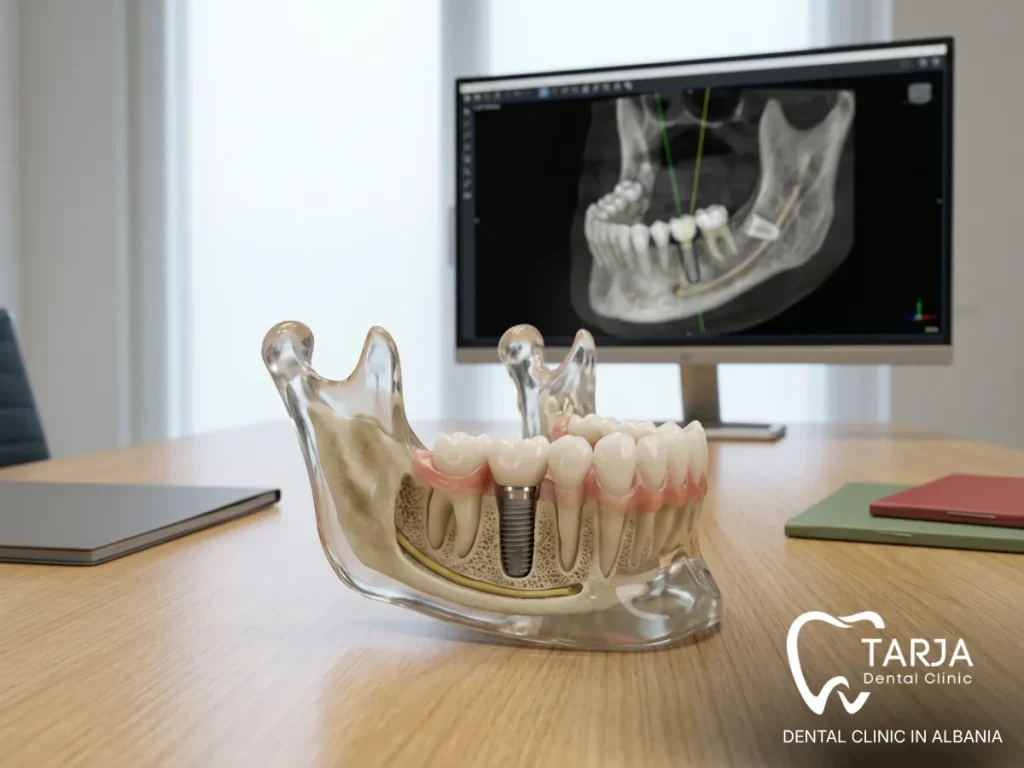
Albania vs Mexico dental implants is not simply a comparison between two lower-cost destinations. It is a choice between two very different treatment journeys. Mexico is closer to the United States and is often easier for a short visit. Albania requires a longer flight, but it can offer compelling value for Americans planning extensive implant work, especially full-arch or full-mouth rehabilitation.
The right answer depends on more than the treatment price. The number of implants, type of final teeth, need for bone grafting, number of visits, surgeon experience, implant system, laboratory work and aftercare can change both the real cost and the clinical outcome.
Short answer: Mexico often makes more practical sense for a single implant, a smaller procedure or a patient who wants the shortest possible journey from the United States. Albania may make more financial and clinical sense for a carefully planned full-arch or full-mouth case when the complete written proposal remains substantially lower after flights, accommodation and a possible second visit are included.
This guide explains how to compare both destinations without treating every clinic in either country as equal. It also shows what American patients should request before booking dental implants abroad.
Albania vs Mexico dental implants: the direct comparison
| Decision factor | Albania | Mexico | What it means for an American patient |
|---|---|---|---|
| Travel convenience | Most journeys from the United States require a connection before arriving at Tirana International Airport. | Direct flights are available from many US cities, and some patients can travel by road. | Mexico normally provides the easier journey. |
| Best fit by case size | Often worth considering for multiple implants, full-arch treatment and comprehensive rehabilitation. | Often practical for one implant, limited restorative work or cases that may require easier return visits. | The larger the treatment plan, the more important the complete written proposal becomes. |
| Number of visits | Many implant treatments require one surgical visit and a later visit for the definitive restoration. | The same biological healing process applies. A second visit may still be necessary, although returning can be easier. | No destination can eliminate the time needed for osseointegration. |
| Clinic selection | A smaller but growing dental tourism market. Patients must verify the individual dentist, clinic and laboratory. | A large market with significant differences among border clinics, resort clinics and specialist centers. | Country reputation cannot replace verification of the treating team. |
| Communication | International clinics often provide English-speaking coordination. Patients should confirm who explains the diagnosis and informed consent. | Many clinics serving Americans communicate in English. Confirm that clinical communication is direct with the dentist. | You must be able to discuss risks, alternatives, materials and aftercare clearly. |
| Travel environment | A European treatment journey centered on Tirana or the Adriatic city of Durrës. | Options range from border destinations to major cities and coastal tourism centers. | Choose the clinic first and build the travel plan around the treatment. |
| Follow-up from the US | Remote communication is important because an in-person return requires more planning. | Returning may be faster and less expensive, depending on the clinic’s location. | Request the complication and adjustment protocol in writing. |
The honest verdict for American patients
Mexico is the logical first comparison for many Americans because geography matters. A shorter flight, similar time zones and easier return travel have real value. If you live in California, Arizona, New Mexico or Texas, the convenience advantage can be substantial.
Albania becomes more persuasive when the treatment is extensive enough for the clinical proposal and total price difference to outweigh the additional travel. A patient replacing one tooth may not save enough to justify a transatlantic journey. A patient comparing full-arch reconstruction on one or both jaws is working with a very different calculation.
Mexico may make more sense when:
- You need one implant or a limited procedure.
- You live close to Mexico or have a convenient direct route.
- You expect that in-person adjustments may be needed.
- The selected Mexican clinic provides the stronger surgeon, treatment plan, materials and follow-up protocol.
Albania may make more sense when:
- You need several implants, All on 4, All on 6 or full-mouth rehabilitation.
- The Albanian proposal remains significantly lower after travel expenses are included.
- You are comfortable planning a European journey and possibly returning after healing.
- You want a coordinated pathway covering surgery, temporary teeth when appropriate, laboratory stages and the definitive restoration.
Do not compare advertised prices
A low starting price can describe almost anything. It may cover only the implant fixture while excluding the abutment, crown, surgical guide, extractions, bone grafting, temporary teeth, definitive bridge, sedation or follow-up appointments.
Full-arch advertising can be even harder to compare because the material used for a provisional bridge may differ significantly from the definitive prosthesis.
Instead of asking which country is cheaper, ask both clinics for a written proposal covering the same clinical scope. If one clinic proposes four implants and a temporary acrylic bridge while another proposes six implants and a definitive zirconia restoration, the totals do not represent the same treatment.
Ask both clinics to itemize these points
- Clinical examination and diagnostic imaging
- Number and planned position of implants
- Implant manufacturer and exact implant system
- Abutment type and manufacturer
- Extractions and treatment of existing infection
- Bone grafting, sinus lift or additional surgery
- Temporary crown, denture or fixed provisional bridge
- Material used for the definitive crown or bridge
- Laboratory fees and try-in appointments
- Medication, sedation and clinical checks
- Number of required visits and duration of each stay
- Maintenance instructions and complication protocol
For a closer look at the variables affecting treatment costs in Albania, read Tarja Dental Clinic’s guide to dental implant costs for American patients. The definitive fee can only be confirmed after examination, diagnosis and case-specific planning.
Compare the total journey, not only the dental quote
The real cost is the complete amount required to reach the definitive restoration and maintain it. This is where an Albania vs Mexico dental implants comparison becomes useful.
Albania total
- Treatment proposal
- Flights with a likely connection
- Accommodation and local expenses
- A second visit when required
- Maintenance and contingency reserve
Mexico total
- Treatment proposal
- Flight, transfer or driving expenses
- Accommodation and local expenses
- Return visits when required
- Maintenance and contingency reserve
Also calculate lost workdays and the cost of changing a flight. A treatment schedule should provide enough time for examination, surgery, laboratory work, fitting and a final clinical check. A travel plan that leaves no time for adjustment is not a bargain.
Why Albania can work well for comprehensive implant treatment
Albania is not automatically better because it is in Europe. Its value comes from a specific combination: lower operating costs than the United States, implant-focused clinics serving international patients, access through Tirana and the ability to coordinate surgical and restorative stages within one treatment pathway.
At Tarja Dental Clinic in Durrës, an international case begins with a preliminary remote review. Patients can share a recent panoramic X-ray, clear dental photographs, relevant medical information and details about current medication.
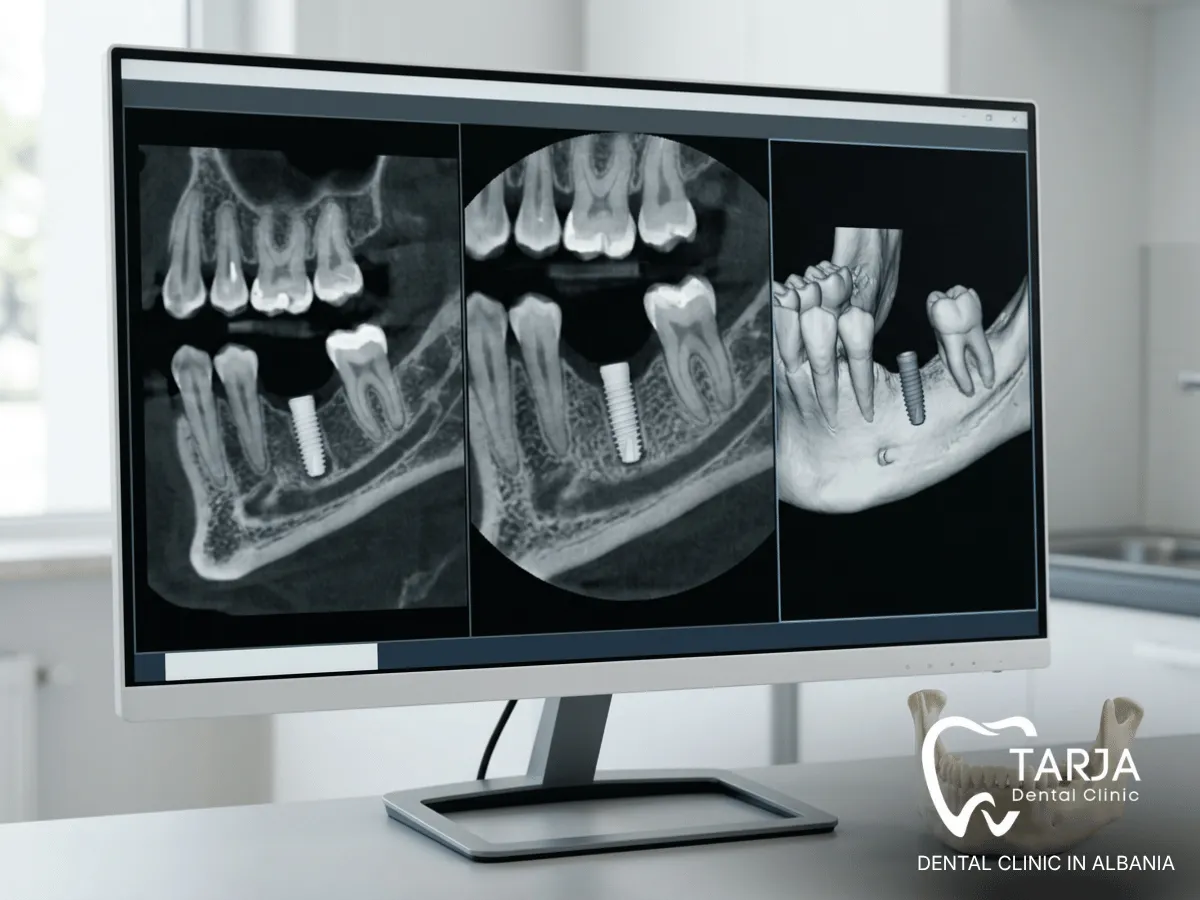
This information helps the team discuss a likely pathway before travel, but it does not replace the clinical examination or required three-dimensional imaging after arrival.
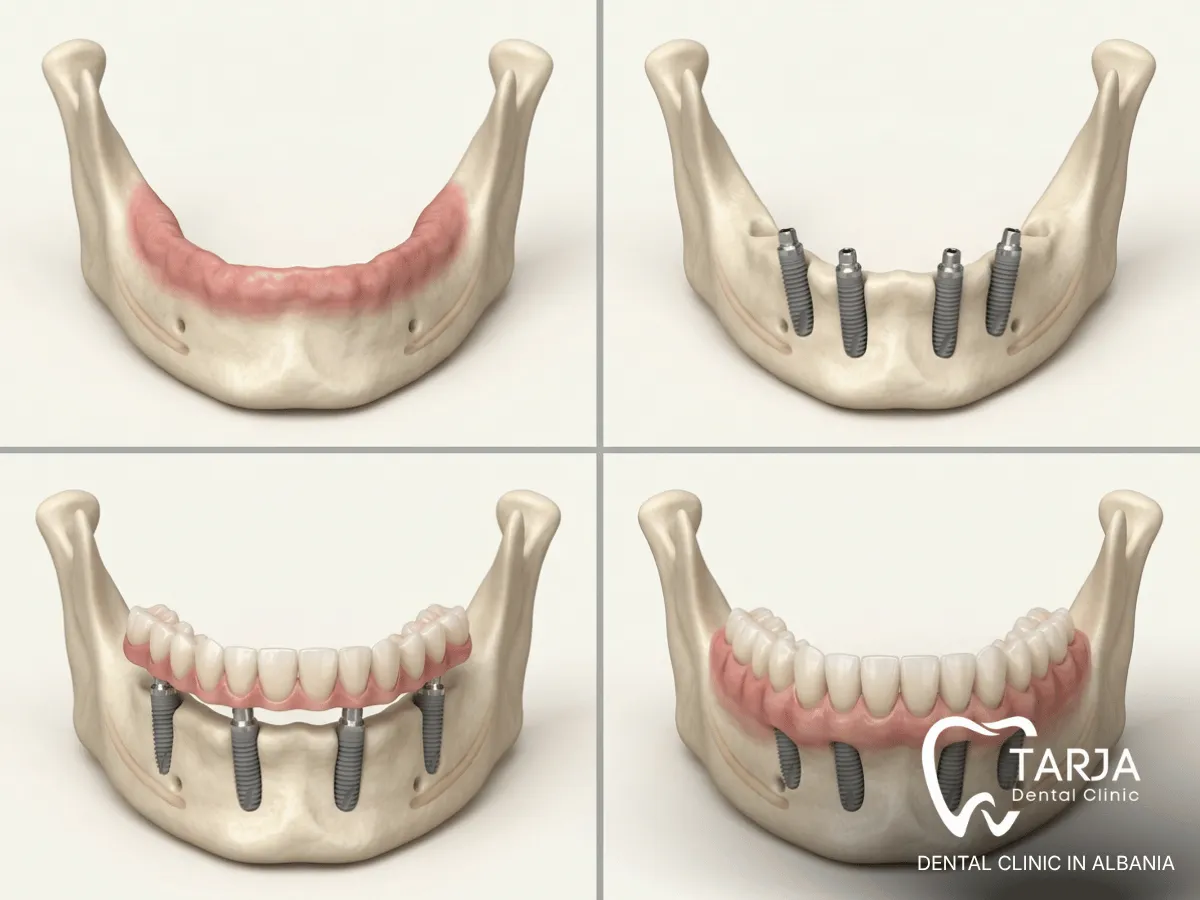
Depending on the findings, the plan may involve single or multiple dental implant treatment, an All on 4 full-arch restoration or an All on 6 treatment.
The number of implants is not selected from a menu. Bone volume, gum condition, bite forces, remaining teeth, medical history and available prosthetic space must all be evaluated.
Patients considering dental tourism in Albania should expect the travel plan to follow the clinical plan. Complex implant treatments often include one visit for surgery and provisional teeth when immediate loading is appropriate, followed by healing and a later visit for the definitive restoration.
Explore possible Albania implant pathways
The following accordion explains what may be discussed during treatment planning. It does not diagnose an individual case or promise that a specific procedure will be suitable.
One missing tooth
Possible single implant pathway
The dentist evaluates the missing tooth site, neighboring teeth, gum health, available bone and the way the upper and lower teeth meet.
- Preliminary review of available images and records
- Clinical examination and three-dimensional imaging when required
- Implant placement after suitability is confirmed
- Temporary tooth options during the healing period
- Definitive crown after adequate healing and osseointegration
- Written hygiene and maintenance guidance
A single implant may offer less total financial advantage after transatlantic travel, so compare the complete journey carefully.
Several missing teeth
Possible multiple implant pathway
The treatment plan determines whether separate implant crowns, an implant-supported bridge or another restorative design is appropriate.
- Review of each missing tooth area and the remaining teeth
- Assessment of bone, gums, bite and prosthetic space
- Written plan identifying implant positions and restoration type
- Temporary restoration options when clinically appropriate
- Healing period followed by the definitive crowns or bridge
- Implant records and aftercare instructions for use at home
Ask clinics in Albania and Mexico to quote the same number of implants, abutments and definitive restorative materials.
Most or all teeth
Possible full-arch or full-mouth pathway
The team assesses the complete arch, remaining teeth, active infection, bone distribution, bite, facial support and the design of the proposed fixed teeth.
- Remote review before travel with the limitations explained clearly
- In-clinic examination and three-dimensional diagnostics
- Comparison of All on 4, All on 6 and alternative treatments
- Extractions and implant surgery only after final consent
- Fixed provisional teeth when implant stability and clinical conditions permit
- Healing period with scheduled communication and checks
- Second restorative stage for the definitive bridge when required
- English-speaking coordination, travel guidance and written aftercare
Comprehensive cases may offer the strongest total value in Albania, but the final choice must follow the clinical findings rather than an advertised package.
Where Mexico has a real advantage
A balanced comparison must state this clearly: proximity is not a minor benefit. It affects flight cost, time away from work, jet lag and the practicality of an in-person review. For patients near the southern United States, Mexico may allow a faster return to the treating dentist when an adjustment is required.
Mexico also has a much larger dental tourism market. That creates more choice, but not necessarily more certainty. Training, equipment, materials, sterilization procedures and follow-up policies can vary considerably among clinics.
A polished website or an all-inclusive package does not prove the quality of the surgery or prosthetic work.
If a Mexican clinic provides a better documented treatment plan, a more appropriate specialist, verifiable implant components and a clearer aftercare process, choosing that clinic can be entirely reasonable. Albania should win the comparison only when the actual treatment proposal is stronger for the individual patient.
The clinic matters more than the country
Dental implant care combines surgery and restorative treatment. The surgeon places the implants, but long-term function also depends on diagnosis, prosthetic planning, laboratory accuracy, bite design, oral hygiene and maintenance.
Comparing countries and package prices without examining the clinical details misses the most important part of the decision.
Questions to ask the treating dentist
- Who will diagnose my case, perform surgery and design the definitive teeth?
- Which implant system and components will be used?
- Will I receive the implant labels, component details and treatment records?
- Why are you recommending this number of implants?
- Which alternative treatments should I consider?
- What could change after the clinical examination and CBCT scan?
- Am I a candidate for fixed provisional teeth?
- Which factors could make immediate loading unsafe?
- Which materials will be used for the provisional and definitive restorations?
- How many days must I remain close to the clinic after surgery?
- Who responds if I experience pain, swelling, looseness or a bite problem?
- Which expenses are excluded from the written proposal?
- Which maintenance schedule should I follow in the United States?
The Centers for Disease Control and Prevention advises medical travelers to consider communication, infection risks, continuity of care and the possible cost of treating complications after returning home.
The American Dental Association’s MouthHealthy resource also encourages patients to examine the risks and practical considerations before arranging dentistry abroad.
Important: A remote quote is preliminary. Photographs and a panoramic X-ray can support early planning, but they cannot confirm implant stability, three-dimensional bone anatomy, gum condition, infection, bite or the definitive prosthetic design. Do not book nonrefundable travel until the clinic has explained what can and cannot be confirmed before arrival.
Treatment timeline: biology does not change at the border
Implant marketing often compresses several separate stages into a phrase such as teeth in one day. Surgery may take place in one day. A fixed provisional bridge may also be provided soon after implant placement in selected cases.
That does not mean biological healing has been completed or that the patient has received the definitive restoration.
Implants normally need time to integrate with the jawbone. The exact healing period depends on the treatment site, bone quality, implant stability, additional procedures, health factors and the protocol selected by the dentist.
A full-arch pathway may include:
- Remote record review and preliminary discussion
- In-person examination and diagnostic imaging
- Confirmed treatment plan and informed consent
- Extractions and implant placement when required
- Provisional teeth when the clinical conditions allow them
- A biological healing and integration period
- A return visit for impressions, try-ins and the definitive restoration
- Long-term professional maintenance
Ask the clinic to distinguish clearly between provisional and definitive teeth. Also ask what happens if the implants do not achieve the stability required for immediate loading. A responsible alternative may involve a removable temporary restoration or a revised treatment schedule.
Aftercare is the biggest practical difference
The CDC notes that follow-up care for complications after treatment abroad can be expensive and may not be covered by US health insurance. Aftercare is therefore part of the purchase decision rather than an optional extra.
Before choosing Albania or Mexico, request written answers to these questions:
- How will routine healing be monitored after I return home?
- Which symptoms require urgent dental or medical care?
- Will the clinic communicate directly with my US dentist when necessary?
- Can replacement implant components be identified and sourced?
- Who pays for diagnostic work, adjustments or corrective treatment?
- Does the warranty cover treatment only or also travel and external dental fees?
- What happens if I cannot return to the original clinic?
A warranty is useful only when its conditions are clear and practical. Read all exclusions relating to smoking, hygiene, missed maintenance, medical changes, grinding and accidental damage.
Never assume that a clinic warranty will reimburse treatment performed by another dentist in the United States.
Travel and entry considerations
US citizens can generally enter Albania without a visa for stays of up to one year, according to current US Department of State information for Albania.
Dental patients normally stay for a much shorter period, but passport validity and current entry requirements should still be checked before booking.
Mexico is easier to reach from the United States, but safety conditions and official guidance vary by state. Review the current US Department of State information for Mexico for the specific location of the clinic.
Travel advisories can change. Check official guidance close to departure and consider enrolling in the Smart Traveler Enrollment Program.
Travel insurance must also be reviewed carefully because ordinary policies may exclude planned dental treatment and treatment-related complications. Ask the insurer for written confirmation of what is and is not covered.
Which destination makes sense by treatment type?
One dental implant
Mexico often has the practical advantage. The cost of a longer journey to Albania can consume much of the treatment saving, particularly when two visits are required.
Albania may still be relevant when the implant forms part of a larger restorative treatment or when the patient is already planning travel in Europe.
Several implants or an implant-supported bridge
Compare complete written proposals. Albania can become financially attractive as the amount of treatment increases, but only when both clinics quote comparable implant components, restorative materials and clinical stages.
Mexico retains the advantage of easier return travel.
All on 4 or All on 6
This is where Albania deserves serious consideration. Full-arch care may involve surgery, a provisional restoration, biological healing and a definitive prosthetic stage.
A coordinated Albanian treatment plan may offer strong total value for Americans willing to make the longer journey. Mexico may still be preferable for a patient who prioritizes proximity or receives a stronger clinical proposal from a selected Mexican specialist.
Full-mouth implant rehabilitation
Do not choose treatment from a package name. Full-mouth rehabilitation may involve both jaws, extractions, management of infection, bone procedures, provisional teeth, bite reconstruction and extensive laboratory work.
The quality of diagnosis and prosthetic planning matters more than the advertised implant count. Request a video consultation and compare every stage line by line.
Why an American patient may choose Tarja Dental Clinic in Albania
Tarja Dental Clinic is located in Durrës, a coastal city within reach of Tirana International Airport. Implant treatment is led by Dr. Arbi Tarja, an implantologist and oral surgeon experienced in individual implants and full-arch rehabilitation.
The clinic supports international patients in English and coordinates preliminary review, clinical appointments, travel guidance and post-treatment communication.
Practical features available to international patients include:
- Preliminary review of available imaging, photographs and medical information
- A likely treatment pathway discussed before travel
- Clinical examination and digital diagnostics before final confirmation
- Planning for dental implants, All on 4 and All on 6 cases
- Provisional restoration options when clinically appropriate
- Coordination of surgical, restorative and laboratory stages
- English-speaking patient support
- Airport transfer and accommodation guidance
- Written aftercare instructions and direct post-treatment contact
None of these features removes clinical risk or guarantees eligibility. Their value is that they make complex international treatment easier to evaluate before the patient spends money on travel.
How to make the final decision
- Collect a recent panoramic X-ray and relevant dental and medical records.
- Request a preliminary consultation from at least two serious clinics.
- Ask each clinic to itemize the same clinical and restorative components.
- Verify the treating dentist, implant system and definitive restoration material.
- Add every flight, hotel night, transfer and lost workday to the calculation.
- Read the aftercare and complication protocol before paying a deposit.
- Do not select a country until you have compared the actual dentists and treatment plans.
If Mexico wins on convenience and the clinical proposal is strong, Mexico may be the sensible choice. If Albania provides a more complete plan and a meaningful total advantage for extensive treatment, the longer journey may be justified.
That is the real answer to Albania vs Mexico dental implants for American patients.
Compare your case with an Albania implant pathway
Send Tarja Dental Clinic a recent panoramic X-ray, clear dental photographs, relevant medical information and a short description of what you want to change. The team can review the records and discuss a preliminary pathway before you decide whether traveling to Albania is appropriate.
Request a personalized implant assessment
The definitive diagnosis, treatment plan and fee are confirmed after an in-person examination and the required diagnostic imaging.
Frequently asked questions
Is Albania or Mexico cheaper for dental implants?
There is no reliable country-wide answer because clinics may quote different implant systems, procedures and definitive restoration materials. Albania can offer strong value for full-arch and full-mouth treatment, while Mexico often reduces travel expenses for Americans. Compare the complete clinical scope and total journey cost rather than the headline price.
Is Albania better than Mexico for full-mouth dental implants?
Albania may make more sense when a comprehensive written proposal remains substantially lower after two journeys, accommodation and aftercare are included. Mexico may be better when proximity and easier return visits are more important. The treating team and clinical plan matter more than the destination alone.
How many times must I travel for dental implants in Albania?
Many implant treatments require two visits. The first may include examination, surgery and a provisional restoration when clinically appropriate. A later visit may be required for the definitive crown or bridge after healing. The exact number and duration of visits depend on the clinical findings and treatment design.
Can I receive permanent teeth immediately after implant surgery?
A fixed provisional restoration may be possible soon after surgery in selected full-arch cases. Eligibility depends on implant stability, bone condition, bite, medical factors and the selected clinical protocol. The definitive restoration is normally completed after biological healing.
Are dental implants in Albania safe for Americans?
Dental implants carry surgical and restorative risks in every country. Safety depends on patient selection, diagnosis, clinician training, sterilization, implant traceability, prosthetic planning and follow-up. American patients should verify these factors for the individual clinic rather than relying on a general claim about Albania.
Do Americans need a visa for dental treatment in Albania?
Current US Department of State information says that US citizens generally do not need a visa for stays in Albania of up to one year. Entry rules and passport requirements can change, so official guidance must be checked before purchasing travel.
What records should I send before requesting a quote?
Send a recent panoramic X-ray when available, clear photographs of your teeth, details of previous implant or restorative treatment, relevant medical conditions, current medications, allergies and your main treatment goals.
A remote review remains preliminary until an in-person examination and any required CBCT imaging are completed.
Will my US dental insurance cover treatment abroad?
Coverage varies by policy. Some plans may provide limited reimbursement, while others exclude overseas treatment or related complications. Ask the insurer for written confirmation and determine which documents are required before treatment begins.
What is the most important question to ask an overseas implant clinic?
Ask who is clinically responsible if the plan changes or a complication occurs after you return home. The answer should explain communication, clinical records, replacement components, urgent care, return visits and financial responsibility.
Medical note: This article provides general information and does not replace an examination, diagnosis or advice from a qualified dental professional. Implant suitability and treatment timing are individual clinical decisions.
