
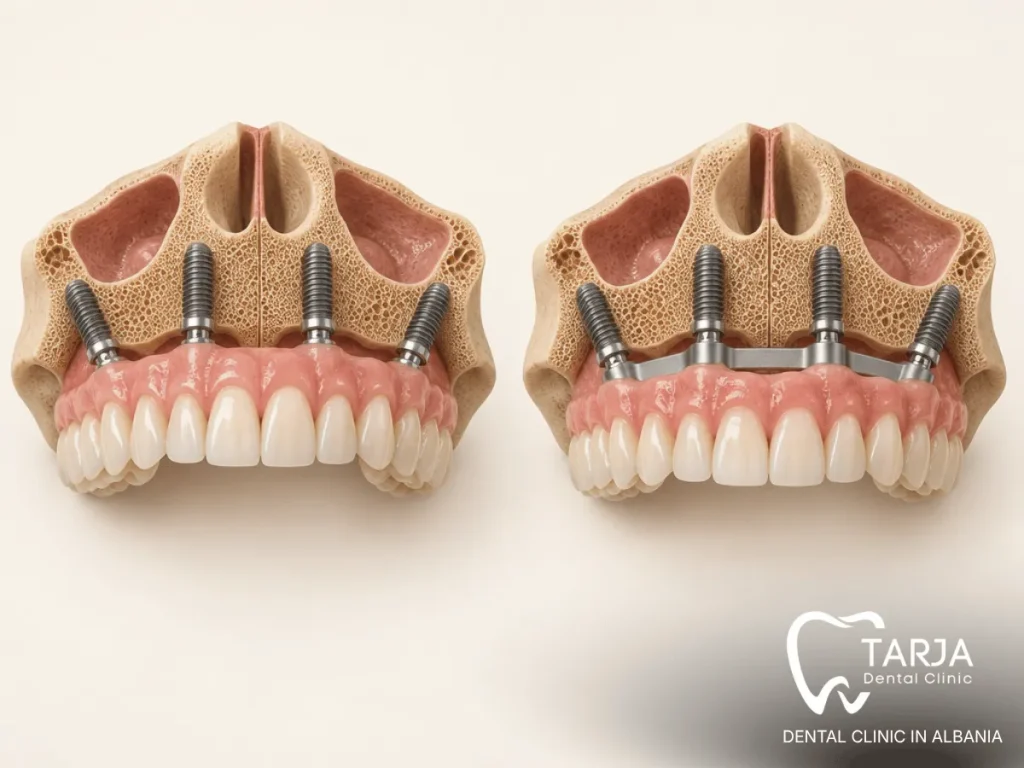
When comparing zirconia vs acrylic All on 4 teeth, the better material depends on more than appearance or price. Both can be used to create a fixed full-arch restoration, but they differ in surface hardness, weight, wear, sound, repairability, maintenance and laboratory cost. The best choice also depends on your bite, available restorative space, opposing teeth, implant positions and expectations.
Zirconia is generally more resistant to staining and surface wear, with a dense ceramic finish that many patients associate with permanent teeth. Acrylic or PMMA is lighter and usually easier to adjust or repair, but the teeth and gingival material can wear, stain or fracture over time. Neither option is automatically right for every patient.
Short answer: zirconia may be preferred when long-term surface stability, stain resistance and a ceramic finish are priorities. An acrylic-titanium bridge may be preferred when lower initial cost, lighter weight and easier repairability are more important. The complete prosthetic design matters more than the material name alone.
Zirconia vs acrylic All on 4 teeth at a glance
| Factor | Zirconia full-arch bridge | Acrylic or PMMA hybrid bridge |
|---|---|---|
| Typical construction | Predominantly monolithic zirconia connected through titanium bases or cylinders; some designs use additional characterization or limited layering | Acrylic or PMMA teeth and gingival material supported by a rigid titanium or metal framework |
| Surface | Dense, smooth and highly polishable | Softer resin surface that may become rougher with wear |
| Resistance to staining | Generally high | More likely to discolor or collect surface stains over time |
| Tooth wear | Low when properly designed, finished and maintained | More gradual wear of the resin teeth and biting surfaces |
| Common maintenance issue | Surface damage, veneering chipping in layered designs, or connection-related complications | Wear, staining, tooth fracture, debonding or replacement of acrylic components |
| Repairability | Minor repairs may be possible, but major fractures usually require laboratory intervention or remake | Often easier to add, adjust or repair with resin |
| Weight | Usually heavier | Usually lighter |
| Feel and sound | Harder ceramic feel and potentially sharper contact sound | Softer contact feel and more muted sound |
| Initial cost | Usually higher | Usually lower |
| Best choice | Determined by bite forces, opposing arch, prosthetic space, hygiene design, repair access, expectations and total treatment plan | |
The table describes common differences, not guaranteed outcomes. “Zirconia” and “acrylic” each include several manufacturing methods, brands and designs. A well-designed acrylic-titanium bridge may perform better than a poorly designed zirconia bridge, and the reverse is also true.
What exactly is being compared?
In this discussion, zirconia and acrylic describe the full-arch prosthesis rather than the implants placed in the jaw. The implant fixtures are normally titanium, regardless of which final bridge material is selected.
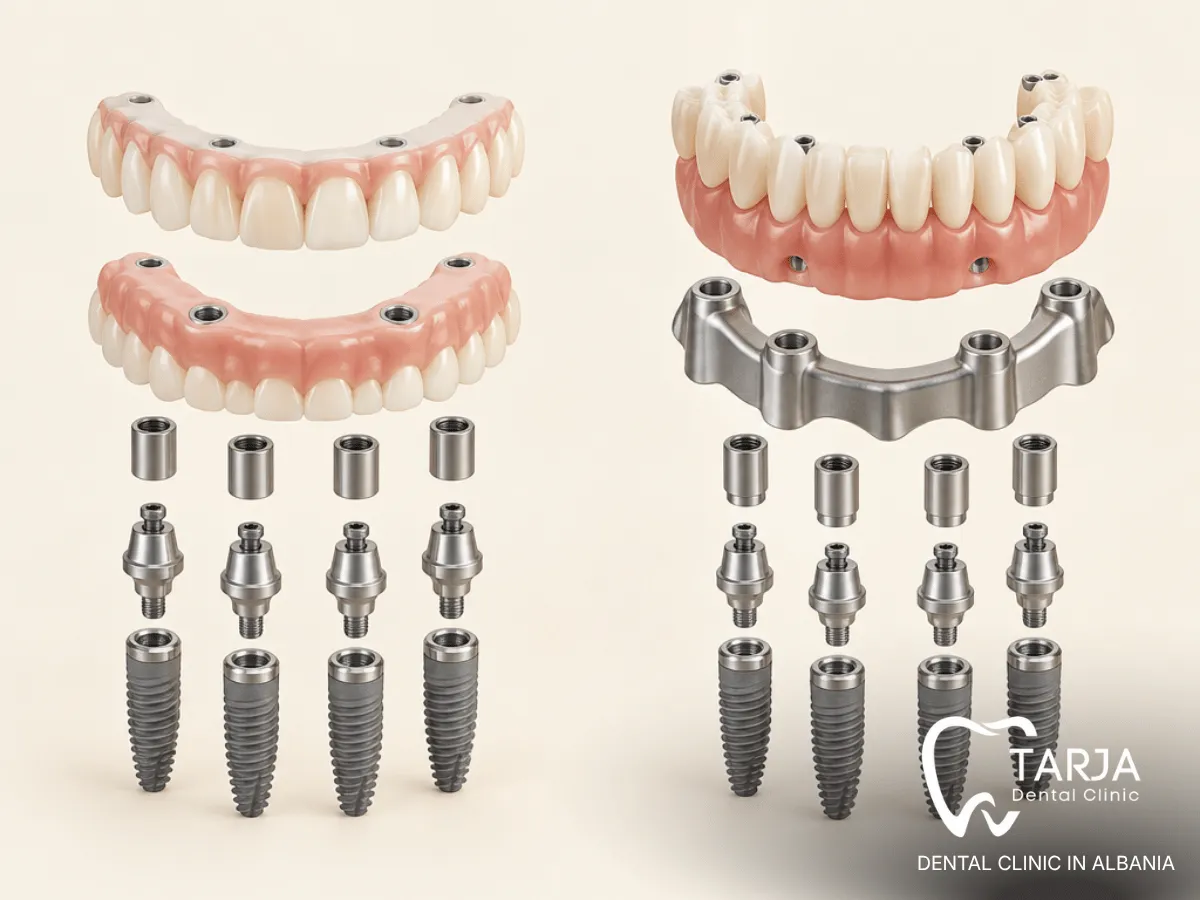
The complete restoration may include:
- Dental implants placed in the jawbone
- Multi-unit abutments that correct the restorative pathway
- Titanium bases, cylinders or another connection system
- A rigid full-arch framework or monolithic bridge body
- Replacement teeth and, when necessary, prosthetic gingiva
- Prosthetic screws that secure the bridge
This distinction is important. A patient may be offered “acrylic teeth,” but the definitive restoration should not be understood as an unsupported piece of plastic. A commonly used definitive design combines acrylic resin or PMMA with a rigid titanium or metal framework.
What are zirconia All-on-4 teeth?
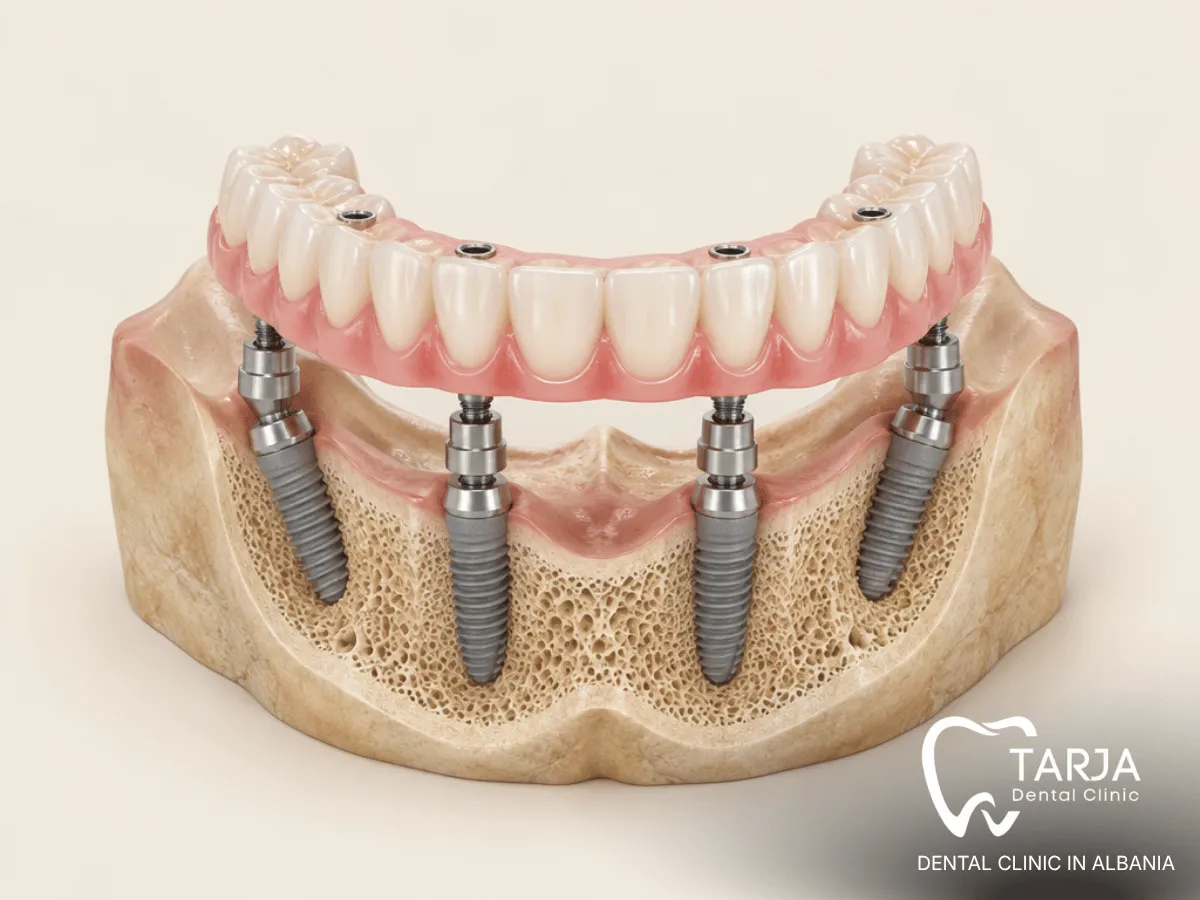
A zirconia full-arch bridge is digitally designed and milled from dental zirconia. Many modern restorations are predominantly monolithic, meaning the main tooth and bridge structure is milled as one strong ceramic unit. Pink characterization may be added to reproduce missing gum tissue, while titanium components create the connection to the implant system.
Some zirconia bridges use veneering porcelain in selected aesthetic areas. Layering can improve characterization, but it also introduces an interface where chipping may occur. For this reason, it is useful to ask whether the proposed bridge is monolithic, minimally layered or extensively veneered.
Potential advantages of zirconia
- High resistance to surface wear
- Good color stability and resistance to staining
- A smooth, dense surface when properly polished
- Natural-looking tooth anatomy and ceramic characterization
- Reduced likelihood of routine acrylic tooth wear
- Digitally reproducible design when the clinic and laboratory retain the records
Potential limitations of zirconia
- Higher initial laboratory and treatment cost
- Greater weight than many acrylic or PMMA designs
- A harder contact feel and sound
- Major fracture or connection failure can be more complex to repair
- Requires adequate material thickness and carefully designed connectors
- Occlusal adjustments must be correctly polished after grinding
What are acrylic All-on-4 teeth?
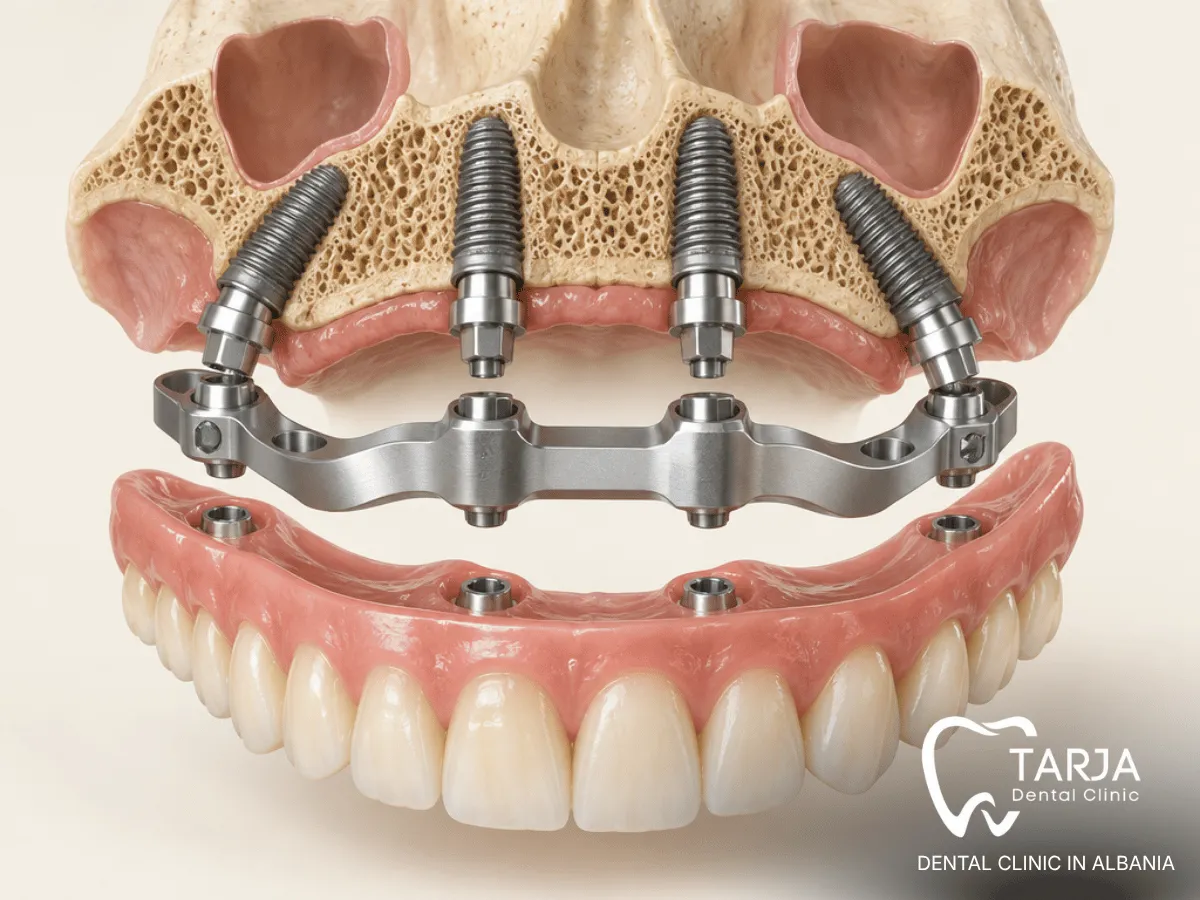
“Acrylic All-on-4 teeth” may refer to several different restorations. A provisional bridge used during implant healing is often produced from PMMA. A definitive acrylic hybrid is different: it commonly combines acrylic resin teeth and gingival material with a rigid titanium or metal framework.
Patients should ask whether the quotation describes a temporary PMMA bridge, a reinforced definitive PMMA bridge, or a traditional metal-acrylic hybrid. These are not interchangeable simply because they all contain resin-based material.
Potential advantages of acrylic or PMMA
- Lower initial cost in many treatment plans
- Lighter overall restoration
- Easier chairside or laboratory adjustment
- Individual teeth or gingival resin can often be repaired or replaced
- More muted sound when the upper and lower teeth contact
- Useful for provisional restorations while tissues and the bite stabilize
Potential limitations of acrylic or PMMA
- Greater surface wear over time
- More susceptibility to staining and loss of polish
- Acrylic teeth may chip, fracture or separate from the framework
- The bite may change as the chewing surfaces wear
- Repairs and replacement of worn components may increase long-term maintenance
Which material lasts longer?
Zirconia is more resistant to wear and staining than acrylic resin, but bridge longevity cannot be predicted from material alone. Implant distribution, prosthetic space, framework design, connector dimensions, bite forces, laboratory quality and maintenance all affect the outcome.
A long-term retrospective comparison of zirconia-based and metal-acrylic full-arch prostheses reported more delayed complications in the metal-acrylic group and higher estimated prosthetic survival for zirconia within that study. However, both groups experienced complications, and the research design does not prove that zirconia is superior for every patient.
A broader systematic review and meta-analysis found high implant and prosthesis survival across several material groups. It also found that chipping and maintenance events were important and that prosthetic survival alone did not fully describe the patient’s likely experience. In other words, a bridge may remain in service while still needing repairs.
The evidence can be reviewed in the long-term zirconia versus metal-acrylic retrospective analysis and the systematic review of prosthetic materials for implant-supported fixed complete dentures.
Does zirconia look more natural than acrylic?
Both materials can produce an attractive smile when the tooth arrangement, proportions, shade, smile line and gingival contours are carefully designed. Zirconia generally maintains its polish and shade more consistently. Its translucency and surface characterization can create a refined ceramic appearance, although the result also depends on the type of zirconia and the laboratory technique.
Acrylic and PMMA can also look natural, especially when tooth position and lip support are correctly planned. Over time, however, the resin surface may become more susceptible to staining, wear or changes in texture.
The most aesthetic material will not compensate for teeth that are too long, too white, poorly positioned or unsupported by an appropriate gingival design. Patients should evaluate the proposed tooth shape, smile width and facial support rather than choosing from material samples alone.
Which material feels more natural?
“Natural” means different things to different patients. Zirconia has a hard, smooth ceramic surface that may feel closer to fixed crowns. Acrylic is lighter and produces a softer, quieter contact sensation. Neither material reproduces the periodontal ligament and sensory response of natural teeth because the restoration is supported by implants.
The shape of the bridge, tongue space, tooth position and bite adjustment often influence comfort and speech more than the material itself. A bulky bridge may feel unnatural in either material. Proper provisional testing can help refine the tooth position, phonetics and cleansability before the final restoration is produced.
Zirconia vs acrylic for chewing and bite forces
Zirconia resists chewing-surface wear, which helps preserve the planned bite when the bridge is correctly designed. Acrylic wears more readily, and significant wear may eventually alter tooth contacts or reduce the height of the teeth.
That does not mean every patient with a strong bite should automatically receive zirconia. Bruxism, implant number, implant distribution, opposing teeth and cantilever length must be evaluated together. A hard material can still fail if the bridge is too thin, the connectors are inadequate or forces are poorly controlled.
Patients who grind or clench may require a protective night guard, scheduled bite checks and a restoration designed for their risk profile. Material choice is only one part of that strategy.
What if the opposite arch has natural teeth or another implant bridge?
The opposing arch changes the forces placed on a full-arch restoration. Zirconia opposing natural teeth, zirconia opposing another zirconia bridge and acrylic opposing a removable denture are different clinical situations.
With zirconia, surface finishing is particularly important. Any adjusted contact area should be carefully repolished according to the material protocol. With acrylic, the dentist should monitor wear and changes in the bite. When both arches are restored, the two prostheses should be planned as one functional system rather than selected independently.
Which bridge is easier to repair?
Acrylic-titanium restorations are usually easier to repair. A fractured or worn acrylic tooth can often be replaced, and gingival resin can frequently be modified. The exact procedure depends on the condition of the framework and whether the bridge can be safely removed.
Small chips in a zirconia restoration may sometimes be smoothed, polished or repaired with resin. A major zirconia fracture, framework problem or damaged connection may require laboratory intervention or a complete remake. Digital records can make reproduction more efficient, but they do not make every failure a simple repair.
Repairability matters for international patients. Before treatment, ask what can be handled by a local dentist, what requires returning the bridge to the original laboratory and whether a temporary replacement can be provided during a major repair.
Which material is easier to keep clean?
A polished zirconia surface is dense and generally resists staining and plaque retention better than a worn or rough resin surface. However, hygiene depends heavily on bridge contours and access beneath the prosthesis.
Either material can become difficult to clean if the tissue surface is overcontoured or leaves inaccessible spaces. The restoration should allow the recommended use of floss threaders, interdental brushes or an oral irrigator without creating food-trapping gaps.
Professional maintenance remains necessary for both materials. The team should check the tissues, implants, prosthetic screws, bite, bridge surface and hygiene access at the prescribed intervals.
Does the final material affect the dental implants?
The zirconia or acrylic bridge sits above the implants and does not change whether the implants integrate with bone. However, the bridge material, framework stiffness, fit and bite design influence how forces are transferred through the prosthesis and its connections.
Research on full-arch restorations shows high survival across different materials, but complications vary. This is why the dentist and laboratory must consider the entire restorative system, not just the visible teeth. A systematic review of framework materials for full-arch implant rehabilitation provides additional scientific context.
What does the research say about zirconia full-arch bridges?
An updated systematic review of monolithic and minimally layered zirconia full-arch prostheses reported high survival and generally satisfactory clinical and aesthetic outcomes in the included studies. The authors also noted the need to interpret the evidence within the available follow-up and study designs.
A large retrospective laboratory-based study evaluated more than 2,000 one-piece zirconia arches and reported high short-term cumulative survival. Its scale is useful, but it should not be read as a guarantee for every zirconia system, laboratory or patient.
For the original evidence, see the updated systematic review of monolithic zirconia full-arch prostheses and the retrospective study of 2,039 zirconia prostheses.
Is acrylic only a temporary material?
No. PMMA is widely used for provisional full-arch bridges during healing, but reinforced acrylic or metal-acrylic designs can also be used as definitive restorations. The important question is not simply whether a bridge contains acrylic. Patients should ask how it is manufactured, reinforced and connected.
A provisional PMMA bridge has an important purpose. It allows the team to evaluate healing, tooth position, speech, lip support, hygiene access and bite before producing the definitive restoration. Calling a provisional bridge “temporary” does not mean that its design is unimportant.
Cost of zirconia vs acrylic All on 4 teeth
Zirconia usually has a higher initial cost because of the material, CAD/CAM production, milling, finishing and laboratory requirements. Acrylic or PMMA options usually cost less initially, although future tooth repairs, relining, surface refurbishment or replacement should be considered.
When comparing quotations, confirm whether the price includes:
- The provisional bridge used during healing
- The final definitive bridge
- A titanium or metal framework
- The number and type of titanium bases or cylinders
- Digital design and laboratory stages
- Try-ins and bite adjustments
- A night guard when clinically advised
- Maintenance, repairs and exclusions
- A replacement option if the bridge cannot be repaired
Do not compare a provisional PMMA bridge from one clinic with a definitive zirconia bridge from another as though they are equivalent. U.S. patients considering treatment abroad can review our guide to dental implant costs in Albania versus the USA and compare every included stage.
Who may prefer zirconia All-on-4 teeth?
Zirconia may be considered when:
- Long-term resistance to staining and surface wear is a priority
- The patient prefers a dense ceramic surface
- There is adequate restorative space for a safe zirconia design
- The implant distribution and bridge dimensions support the material
- The patient accepts the higher initial cost and more complex major repairs
- The opposing arch and bite can be managed appropriately
Who may prefer acrylic or PMMA All-on-4 teeth?
An acrylic-titanium or reinforced PMMA bridge may be considered when:
- A lower initial cost is important
- Lighter bridge weight is preferred
- Easier future modification and repair are priorities
- The treatment is still in the provisional or diagnostic phase
- The patient understands that wear, staining and repairs may occur
- The framework and prosthetic design provide adequate rigidity
Questions to ask before choosing your final bridge
- Is this bridge provisional or definitive?
- If it contains acrylic or PMMA, what framework reinforces it?
- If it is zirconia, is it monolithic, minimally layered or fully veneered?
- Which zirconia or PMMA system will be used?
- How much restorative space is available?
- How does my opposing arch affect the recommendation?
- Do I show signs of grinding or clenching?
- How will the bridge be cleaned underneath?
- Which repairs can be completed locally?
- What is included in the maintenance and repair policy?
- Will the digital design files be retained for a future remake?
How the final material fits into All-on-4 treatment
Material selection comes after diagnosis and prosthetic planning. The dentist must first determine whether All-on-4 implant treatment is clinically appropriate, where the implants should be positioned and whether the bridge can be designed with suitable support and hygiene access.
The number of implants is a separate decision from the bridge material. If you are still comparing treatment configurations, read our guide to All-on-4 versus All-on-6 dental implants. A six-implant bridge is not automatically zirconia, and a four-implant bridge is not automatically acrylic.
The treatment normally includes implant placement, a provisional phase, osseointegration and delivery of the final bridge. Our guide to dental implant recovery explains why receiving provisional teeth does not mean healing is complete.
Planning zirconia or acrylic All-on-4 teeth in Albania
At Tarja Dental Clinic in Durrës, the final restoration is considered as part of the complete dental implant treatment plan. The assessment includes bone anatomy, implant distribution, restorative space, bite forces, smile design, opposing teeth and maintenance access.
International patients may send recent imaging and dental photographs for a preliminary review, but the final diagnosis and material recommendation require an in-clinic examination and the necessary records. Patients should avoid booking non-refundable travel until the likely treatment stages have been discussed.
Our dental tourism in Albania page explains how clinical planning, provisional teeth, healing, the final restoration and aftercare fit into the travel pathway.
Frequently asked questions
Which is better, zirconia or acrylic All-on-4 teeth?
Zirconia offers greater resistance to wear and staining, while acrylic-titanium bridges usually cost less and are easier to repair. The better choice depends on your bite, opposing teeth, restorative space, implant configuration, budget and maintenance priorities.
Do zirconia All-on-4 teeth break?
Zirconia full-arch bridges have shown high survival in published studies, but complications can still occur. These may involve the zirconia, veneering material, titanium components, screws or implant connections. Proper design and sufficient material thickness are essential.
How long do acrylic All-on-4 teeth last?
There is no single lifespan that applies to every acrylic bridge. The framework design, bite forces, hygiene, smoking, opposing arch and maintenance affect longevity. Acrylic teeth and gingival material may require repair or replacement as they wear.
Does zirconia stain?
Zirconia is highly resistant to intrinsic discoloration and generally retains a smooth surface well. External deposits can still accumulate, especially if hygiene is difficult or the surface has been roughened.
Can acrylic All-on-4 teeth be upgraded to zirconia later?
Often a new zirconia bridge can be produced after the implants have integrated, but this should not be assumed to be a simple material swap. The dentist must verify implant positions, restorative space, bite, abutments and the accuracy of the required records.
Is zirconia too heavy for four implants?
Weight alone does not determine whether a zirconia bridge is appropriate. Implant distribution, bone support, bridge dimensions, cantilever length, connection design and bite forces must be assessed together.
Are PMMA and acrylic the same?
PMMA is a specific acrylic polymer widely used in dentistry. The term “acrylic bridge” can describe different resin systems and constructions, so patients should ask which material, manufacturing process and reinforcement are included.
Can I have zirconia on one arch and acrylic on the other?
Mixed material plans are possible, but the interaction between the arches must be evaluated carefully. The dentist should consider wear, bite forces, sound, maintenance and the long-term plan for both restorations.
Final verdict: choose the complete design, not only the material
The practical answer to zirconia vs acrylic All on 4 teeth is not that one material always wins. Zirconia generally offers better resistance to staining and wear, while acrylic or PMMA usually provides lower initial cost, lighter weight and easier repairs.
The safest recommendation is based on the full restorative system: implant positions, titanium connections, framework, material thickness, opposing teeth, bite, hygiene access and repair plan. Ask to see exactly what is included in the provisional and definitive stages before comparing prices.
Tarja Dental Clinic can review your available records and explain which full-arch material may suit your treatment plan. Request a personalized preliminary assessment before organizing your dental trip.
This article provides general educational information and does not replace an examination, diagnosis or individualized treatment advice from a qualified dental professional.
